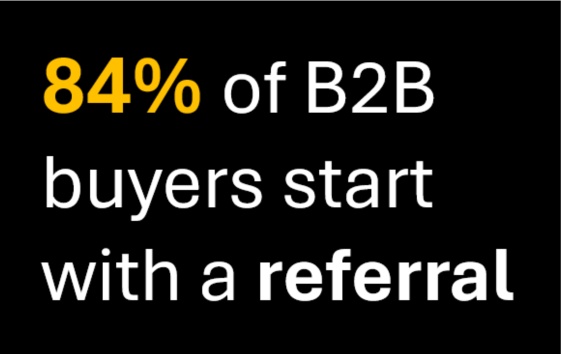
Referrals have always been powerful.
But something has changed.
What used to be occasional is becoming consistent — and more important.
In a world of more outreach, more automation, and more noise, how you access people matters more than ever.
We built entire systems around cold outreach — tools, teams, and metrics.
We never did the same for warm.
That’s the gap.
B2B was never meant to be a numbers game. It was built on conversations, credibility, and one person believing in another.
The biggest deals still come the same way they always have — through trusted introductions.
What’s changed isn’t whether relationships matter, but whether companies are building for them.
The performance gap isn’t subtle. Referrals consistently outperform every other growth channel:
Referrals don’t just perform better — they dominate outcomes.
Yet most organizations still treat them as:
No serious operator doubts the power of warm introductions.
The issue is that relationships don’t scale on memory, inboxes, and spreadsheets.
Most advisor-led or referral-driven efforts break down because:
When programs stall, the conclusion is often:
“Advisor programs don’t work.”
The reality is simpler:
Unsystemized advisor programs don’t work.
Modern go-to-market stacks are powerful — just not for trust.
We’ve built infrastructure for leads, pipelines, and outreach —
but not for who trusts whom enough to open a door.
That missing layer is why referrals outperform everything — and why most companies can’t scale them.
Advisors, operators, and trusted connectors are the reason referrals convert better, close faster, and last longer.
Yet they’re often given:
As a result, valuable relationships go unused — not because people don’t want to help, but because the system was never designed to support them.
Cold outreach still exists — but it’s no longer the advantage.
As AI increases noise and automation floods inboxes, access has become the bottleneck.
The companies pulling ahead aren’t sending more messages.
They’re earning more introductions.
They understand that referrals aren’t a tactic — they’re a growth engine.
And growth engines require infrastructure.
Referrals already run B2B growth.
The opportunity now is to finally treat them like it:
Because the future of B2B growth won’t belong to the loudest companies —
but to the most trusted ones.
The companies that figure this out won’t just perform better.
They’ll operate differently.
True relationships. Real results.
#WarmRelationships #B2BGrowth #Referrals #AdvisorPrograms #TrustDrivenGrowth #FutureOfSales #GTMStrategy #RelationshipCapital