We’ve all asked for — or made — introductions.
And as cold outreach becomes more saturated (especially with AI massively increasing outbound noise), trusted relationships and warm introductions are becoming one of the most valuable channels in business.
But not all warm intros are equal. Some create momentum immediately. Others go nowhere.
After years focused on warm relationships and building systems around scaling high-quality introductions, I started noticing patterns behind the introductions that actually drive outcomes.
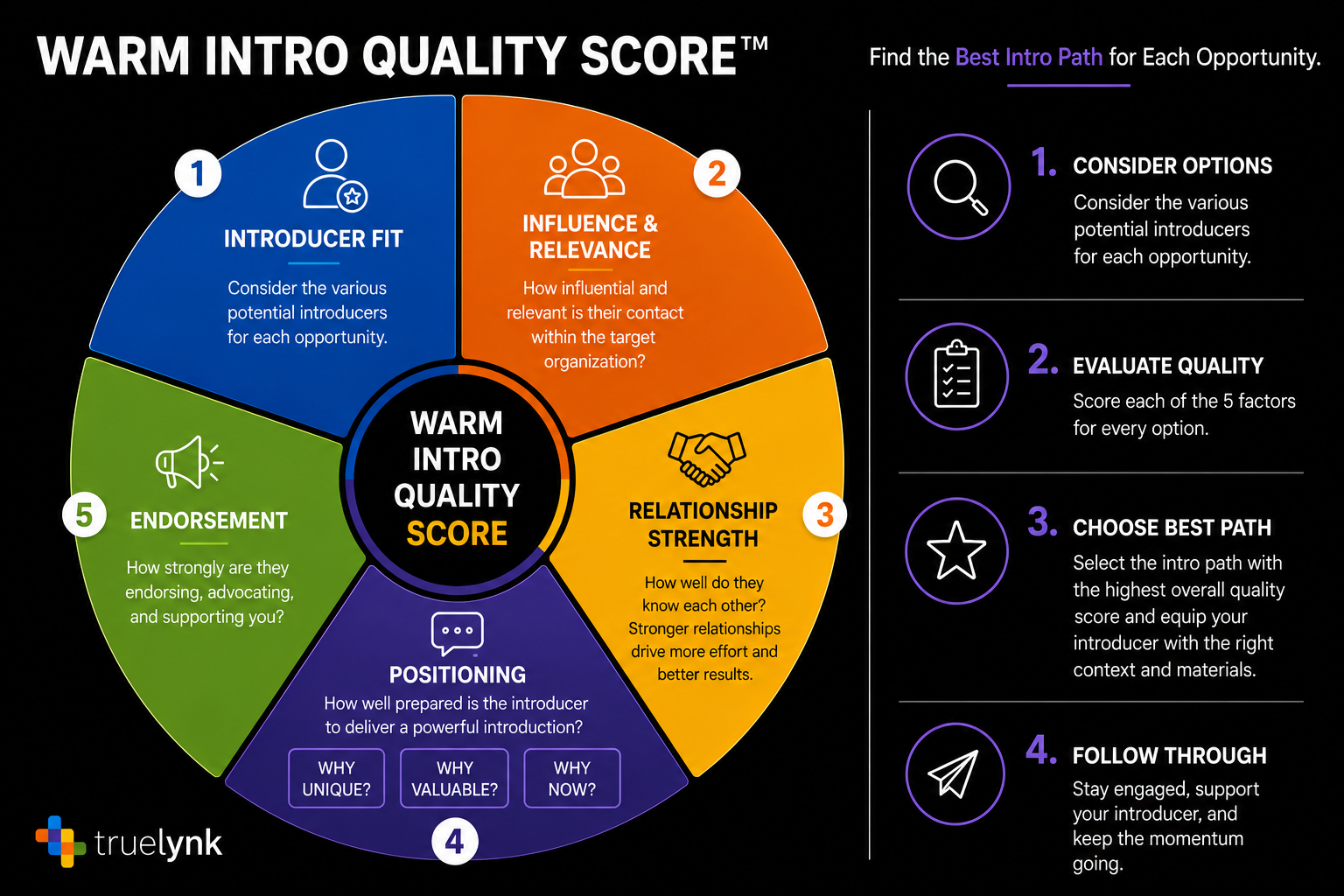
That led us to develop a simple framework to help evaluate the quality of an introduction path before making the introduction. We call it the:
The goal is simple:
Not just:
“Who do I know?”
But:
“What is the highest-quality path into this opportunity?”
Who is making the introduction?
The credibility, relevance, and positioning of the introducer matters significantly.
The right introducer can instantly increase trust, alignment, and engagement.
Key considerations:
How influential and relevant is the contact within the target organization?
Not every connection creates the same opportunity.
Some contacts can influence a meeting. Others can influence an actual decision.
Key considerations:
How strong is the relationship?
The strength of the relationship often determines:
Stronger relationships typically drive stronger outcomes.
Key considerations:
How well is the introduction positioned?
A great introduction is not simply:
“You should meet.”
Strong positioning creates context, relevance, urgency, and curiosity.
We often think about positioning through 3 lenses:
Why Unique?
What makes this different?
Why Valuable?
Why should they care?
Why Now?
Why is this relevant now?
Equipping your introducer with the right context and messaging can dramatically improve outcomes.
How strongly is the introducer advocating and supporting you?
There is a major difference between:
The strongest introductions often involve:
Key considerations:
As AI continues to scale outbound communication and cold outreach volume increases, access itself is becoming more commoditized.
Relationships, trust, credibility, and high-quality introductions are becoming increasingly valuable differentiators.
Warm introductions are no longer simply a networking advantage.
They are becoming:
The goal is no longer simply to know people. The goal is to identify the highest-quality path into an opportunity.
Because the strongest outcomes rarely come from random introductions — they come from strategically aligned relationships, strong positioning, real trust, and active endorsement.
That is the thinking behind the Warm Intro Quality Score™ framework.